
Keep your unsolicited, one-directional advice
Colleague, Interrupted by a Partner who just needed to hear himself speak

Most people I know love giving advice. I do too. It’s part of the reason I have now become a sales coach at my firm. I advise our leadership on how they can win deals with clients, which ranges from strategic positioning to preparation for pitches. There’s just something about seeing people get results under your guidance.
There is also an art to knowing when and how not to give advice.
Recently, I was chatting with one of our Partners (i.e. one of our leaders) of my firm. When he asked what I was up to, I explained that I was now a sales coach, and thereby a part of our internal sales support team. He didn’t ask any follow-up questions to show interest. No, he immediately said:
“You need to do something about the PR of your sales team.”
For context: in our firm we have supporting sales processes & tools which are meant to help you position better towards clients. In reality, many people do not take them seriously and as a result they are viewed as an admin burden. Understandable, but a shame. You know how it goes in big corporates.
So, I wanted to say:
“Well, we are actually only involved in the big deals over 1 million, so it is very hard to influence everyone across the business on the use of the tool. But I agree the perception should change - do you have any suggestions on how we can do that?”.
What actually happened is I couldn’t get any further than:
“Well, we are actually only involved in the big deals over 1 million”…
AND THEN HE CUT ME OFF.
He interrupted me by repeating more or less what he already said:
“No no, listen, you really should improve your PR”.
And then I proceeded to listen to a 30 second rant in which he said exactly the same thing, but using different words. It turns out my publication name Colleague, Interrupted wasn’t just a clever name… It’s autobiographical.
The thing that he wanted to hear from me was probably:
“Oh good Sir, you are completely correct. How did I not think of this before? I’m so glad I ran into you today and that you shared this piece of wisdom with me! Thank you for gracing me with your presence.”
The only thing I actually managed to say was:
“Yeah you’re right, thanks I’ll look into it.”
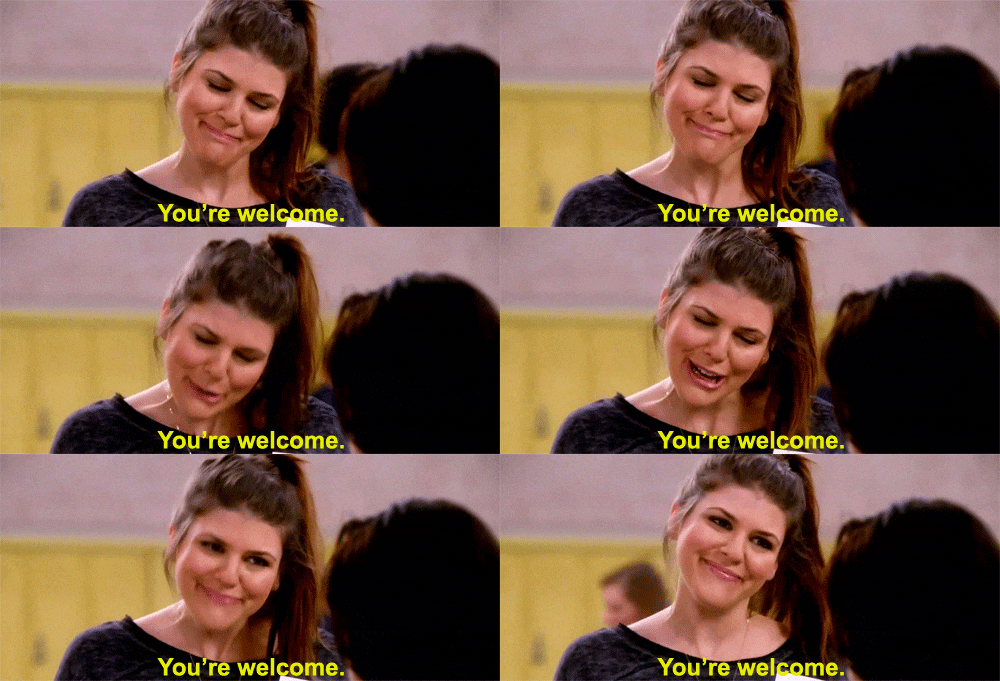
I won’t. The whole interaction felt very much like Sadie from Awkward giving me advice: loud, self-assured, entirely uninterested in context. Just here to deliver the one-liner and walk off like it’s gospel.
Advice as a power play
In consulting, not every conversation is about solving a problem. Sometimes it’s about performing competence. Sometimes it’s about reminding you who gets to hold the mic — literally and metaphorically.
This wasn’t really about sales tools or internal perception. This was a power play, which you only notice once you’ve been around long enough to spot the pattern: someone offers “advice,” but it’s not to be helpful. It’s to assert something: usually their authority, insight and/or superiority.
Ironically, I actually agreed with him. We do need to address this and improve the perception of our team. But I didn’t get the chance to say that. Because the point wasn’t the idea, it was his need to be the one to say it.
The consultant in me walked away thinking:
If advice is a gift, can I return it unopened?
The lesson for coaches
The coach in me, on the other hand, walked away with a different question: have I ever done this too?
It’s uncomfortable to say, but I probably have. I’ve probably rushed to fill the silence. I’ve probably wanted to sound smart more than I wanted to be helpful. Tricky!
Coaching, really good coaching, starts with curiosity. It asks more than it tells. It assumes you don’t have the full picture, even if you’ve seen a hundred versions of it before. It’s not about giving the “right” advice. It’s about helping someone arrive at the right question.
Andrea Chiarelli and I even developed a playbook on using curiosity at work, specifically active listening, precise language, going with the flow. This Partner could’ve used it.

So, advice should be an offering. Not a one-directional monologue. And certainly not a power move.
Curious to read more? While I was writing this, Elina posted a great piece on why advice, especially unsolicited advice, so often lands badly. If this topic resonates, I recommend giving it a read. It’s a perfect complement. In my case, there was definitely some contextual mismatch at play… which probably explains why the whole thing left me feeling more patronized than supported.
Now, I would like to invite you to share your opinion. Ever been on the receiving end of advice like this? What lessons have you learned? Or do you have other views on the matter? I honestly, seriously, truly would like to hear them!
Looking forward to hearing your experiences!
Yours in weird leadership interactions,
Cécile
Thanks for reading Colleague, Interrupted. I’m Cécile, a management consultant and coach at a Big Four consulting firm in Europe. I write the things I can’t say in meetings. Mostly, I turn corporate rage and hard-earned lessons into advice for anyone in their 20s or 30s trying to build a successful career. I help you be the best version of yourself, so you get promoted faster without losing your mind.
Such a great post! I wish leaving professional life behind meant leaving this kind of intrusive behavior behind, too. But I've come across it recently in the homeschooling world. You were kind enough to try and find a connection by acknowledging what he said, and you weren't even allowed to finish your thought to do that. I'm frustrated for you. But I also really value the way you reframe these experiences as lessons we can learn from in our connections with other colleagues or even in everyday life.